
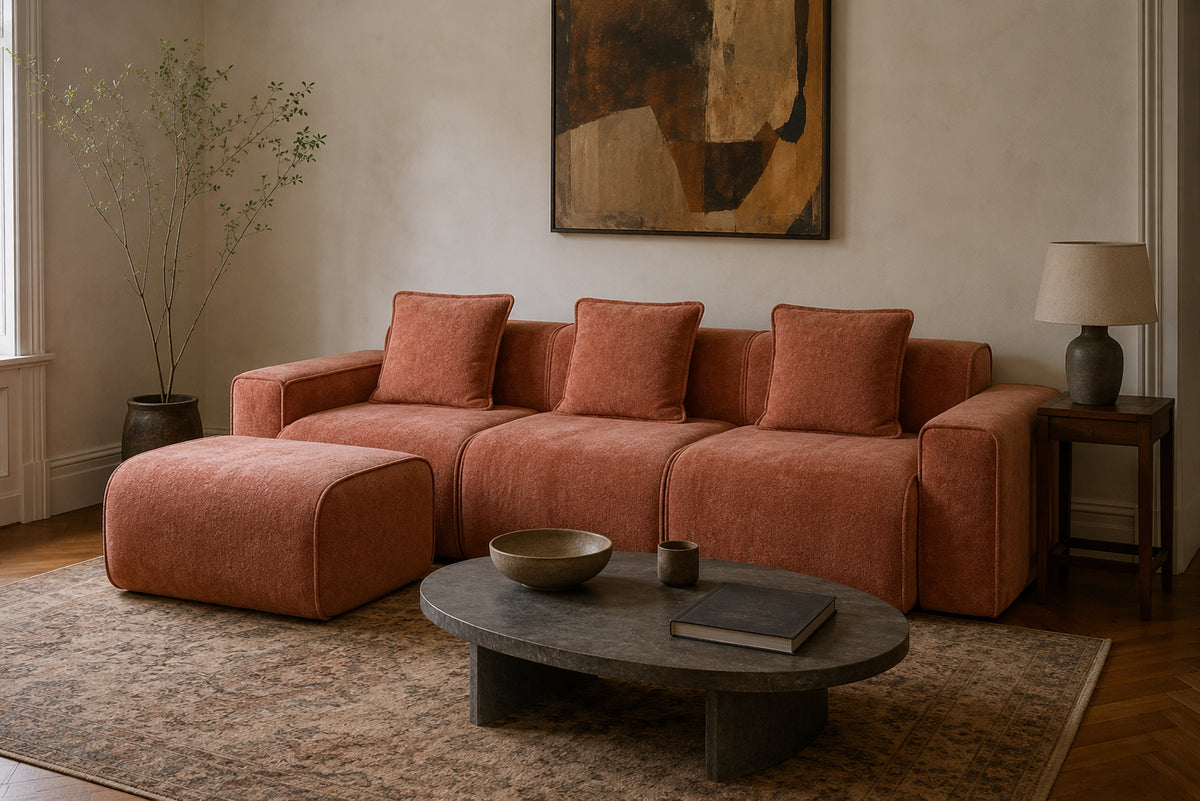

How to Decorate a Round Coffee Table
Decorate a round coffee table from the center outward in a triangle, not left to right in rows. A circle has no long axis and no front, so it gets read from every seat at once, and the arrangement that works is three groupings set at roughly equal distance from the center. Keep the tallest object low enough that the object plus the table height stays under about 28 inches, which is roughly seated eye level across a seating group. Leave the outer 3 to 4 inches of the top clear so nothing sits out on the curve, and start with one round or oval tray, because a tray whose edge matches the table's does more work on a circle than any other object.
Why a circle needs a different formula than a rectangle
Most coffee table styling advice is built on a long axis. Put the tray at one end, the books at the other, something tall between them, and the arrangement reads as a line because the table is a line. A round table takes that away. Every radius is the same length, so there is no end to anchor to and no short side to leave empty. Composition has to run from the center out instead.
The second difference is sightlines. A rectangular table pushed up against a sofa has a back edge, and you can hide the dull side of an object there. A round table usually sits in the middle of a seating group, which means it gets looked at from three or four directions at once. Nothing on it has a back.
The third difference is area, and it catches people out. A 31.5 inch round top is about 779 square inches. A common 48 by 24 inch rectangular top is 1,152 square inches. The round table gives you roughly two thirds of the surface, on a footprint that looks bigger in the room. Editing matters more on a circle than it does on a rectangle.
How much surface you are actually working with
Top area grows with the square of the diameter, so small jumps in diameter buy more room than they look like they should. Going from 27.5 inches to 35.4 inches adds about 8 inches of diameter and about 390 square inches of top.
| Diameter | Top area | Styling area after a 4 in clear rim |
|---|---|---|
| 23.8 in | 445 sq in | about 200 sq in |
| 27.5 in | 594 sq in | about 300 sq in |
| 31.5 in | 779 sq in | about 434 sq in |
| 35.4 in | 984 sq in | about 594 sq in |
| 39.4 in | 1,219 sq in | about 779 sq in |
The right column is the number worth planning around. Keeping a clear band of 3 to 4 inches around the rim costs you close to half the top on a smaller table, and it is what keeps a mug from getting knocked by a sleeve and a vase from being set out on the curve where it has the least support. Diameters are published in the specifications on each listing, so check the one you own or are buying rather than estimating from a photo.
Start with a tray, and match its edge to the table's
A tray is the single most useful object on a round table because it turns three or four loose items into one shape. On a circle, the shape of the tray matters as much as its size. A round or oval tray repeats the table's curve and reads as part of it. A square or rectangular tray sets up a conflict, and the conflict shows up at the corners.
Here is the arithmetic. On a 31.5 inch top, the radius is 15.75 inches. Center a 16 inch square tray on it and the middle of each side sits 7.75 inches from the rim, which looks fine, but the corners reach 11.3 inches out from the center and sit only 4.4 inches from the edge. The tray looks centered and crowded at the same time. If you want a square tray on a round table, size it so the corners still clear the rim band, which usually means a square no wider than about 40 percent of the diameter.
For a round tray, half the table diameter is a reliable starting point: a 15 to 16 inch tray on a 31.5 inch top, an 18 inch tray on a 35.4 inch top. That leaves a visible ring of tabletop around it, which is what makes the tray look chosen rather than wedged in.
Build in a triangle, not a line
With no long axis to work along, the arrangement that holds up from every seat is a triangle: three groupings spaced around the center, each a different height. One tall, one medium, one low. Three works because an odd number of points cannot split into two matching halves, so the eye keeps moving around the table instead of stopping at a seam.
A few specifics that make the triangle work:
- Set the groupings off center rather than ringing the rim. Pulling them in toward the middle leaves the clear band intact and keeps the composition feeling deliberate.
- Leave one of the four quadrants genuinely empty. That is where drinks, a phone and a remote go, and if you do not plan for it, the styling gets dismantled within a day.
- Vary the footprint, not just the height. Three objects of similar width at different heights still read as a cluster of columns.
On height, use the table as part of the measurement. A tall object on a low drum table and a short object on a tall pedestal can land in the same place. Add the table height to the object height and keep the total under roughly 28 inches so the arrangement sits below the eye line of someone seated on a standard sofa. On a 13.8 inch table that allows an object up to about 14 inches. On a 20 inch table it allows about 8 inches.
Table height decides what fits on top
Round coffee tables cluster low, which is good news for styling, because low tables read as a platform and let flat arrangements work. Across a sample of 26 in-stock round coffee tables in the Round Coffee Tables collection, checked on November 19, 2026, published heights ran from 12.0 to 20.0 inches, with a median of 13.8 inches and 23 of the 26 falling between 12 and 16 inches. That is a sample rather than a count of the whole collection, so treat it as the shape of the range and not as a guarantee about any single listing.
What that means in practice:
- Low drum tables, 12 to 14 inches. The top behaves like a plinth. Books lying flat, a shallow bowl, a low sculptural object. The Beige Travertine-Look Round Drum Coffee Table, 31.5 in, 12.4 in Tall sits at the bottom of that range and gives you the most headroom for a taller vase.
- Mid-height round tables, 15 to 17 inches. Closer to sofa seat height, which is comfortable to reach, but the usable height above the top shrinks. Go lower and wider with objects here.
- Tall round tables, 18 inches and up. These are usually doing a second job. The Brown Round Swivel-Top Coffee Table with Shelf and Casters, 39.5 in stands 20 inches high with a swivel top and a lower shelf, so the styling lives on the shelf and the top stays clear for use.
Pedestal and drum bases: keep the weight near the middle
Most round coffee tables stand on a single pedestal, a drum, or a narrow central base rather than four corner legs, and that changes where heavy objects should sit. A top that overhangs its base is a lever. Push a stone bowl out to the rim and you are applying load at the point of least support.
A concrete example from the catalogue: the Walnut Fluted Round Drum Coffee Table, 31.5 in has a 31.5 inch top over a 17.7 inch base diameter, so the top overhangs the base by about 7 inches all the way around. Its published tabletop weight capacity is 350 lbs. Construction: solid pine sides with pine veneer over MDF panels. The capacity is not the issue at normal styling weights, but the geometry still argues for putting the heaviest object closest to the center and keeping the rim for light things.
If you want a second tier, a table with storage or a shelf solves the editing problem by giving the clutter somewhere to go. The Natural Rope and Rattan Round Drum Coffee Table with Storage, 31.5 in has a flip top with published capacities of 88 lbs on the tabletop and 55 lbs inside, which is where remotes and coasters belong. The Walnut Glass-Top Round Pedestal Coffee Table with Shelf, 31.5 in takes the opposite approach: a 6 mm tempered glass top at 14 inches high with a shelf visible through it, so whatever sits below becomes part of the arrangement whether you planned it that way or not.
What works on a circle, and what fights it
Four object types carry almost every round table arrangement. A tray to group the small things. One low sculptural object with some mass to it, a stone bowl or a chunky candle holder. A short stack of books laid flat, two or three at most, which gives you a plinth to set something on. And something organic, a plant, branches, or a single stem.
Things that reliably look wrong on a round top:
- Long low objects. A table runner, a narrow rectangular box, a row of three matched candlesticks. They all declare an axis the table does not have.
- Square trays and books pushed to the edge. Straight edges on a curve leave wedge-shaped gaps that read as mistakes.
- Tall narrow vases on a narrow pedestal. Top-heavy on a base that is already narrow, and they block sightlines across the group.
- Too many small items. A round table has less area than its diameter implies, and small objects spread across it look like things set down rather than things placed.
Material changes the approach too. A sintered stone or stone-look top already has pattern and movement in it, so it wants fewer and plainer objects. The Walnut and Black Sintered Stone Tiered Round Coffee Table, 31.5 in is one of those: let the top be the decoration and add one tray. A plain wood or woven top is quieter and will carry more. Browse the Sintered Stone Coffee Tables and Wood Coffee Tables collections side by side and the difference in how much styling each wants is obvious.
Round tables with sectionals and curved seating
A round table earns its place in an L or U shaped seating arrangement, because the distance from the table to every seat stays roughly equal, which a rectangle cannot manage in the same layout. Keep 14 to 18 inches between the seat edge and the table all the way around, not just at the front. Our guide on how far a coffee table should be from the couch has the clearance numbers in detail.
One honest limitation. The standard proportion guideline puts a coffee table at about two thirds the length of the sofa it faces, which is about 56 inches for an 84 inch sofa and 48 inches for a 72 inch one. Round coffee tables do not get that big in most catalogues, this one included, where the larger diameters top out around 39 inches. In front of one long sofa, a single round table will read small. The fixes are to center it in a seating group rather than in front of a single sofa, to pair it with a second small table, or to use a nesting coffee table set so two circles cover the span. For shorter runs and loveseats, a single round table in the 27 to 32 inch range lands right where the proportion rule wants it.
Frequently asked questions
How do you decorate a round coffee table without it looking cluttered?
Limit yourself to three groupings and leave one quarter of the top completely empty for drinks and everyday items. The reason round tables tip into clutter faster than rectangular ones is area: a 31.5 inch round top is about 779 square inches against 1,152 for a common 48 by 24 inch rectangle, so the same number of objects covers a much larger share of the surface. Keeping a clear 3 to 4 inch band around the rim also helps, because the empty ring of tabletop is what makes the arrangement in the middle look intentional.
What size tray fits a round coffee table?
For a round or oval tray, start at about half the table diameter, so a 15 to 16 inch tray on a 31.5 inch top and an 18 inch tray on a 35.4 inch top. Square trays need to be smaller, because their corners reach further than their sides: a 16 inch square centered on a 31.5 inch top leaves 7.75 inches of tabletop at the middle of each side but only 4.4 inches at the corners. As a rule, keep a square tray to about 40 percent of the diameter so the corners still clear the rim.
How tall should objects on a round coffee table be?
Add the object height to the table height and keep the total under roughly 28 inches, which keeps the arrangement below the eye line of someone seated on a standard sofa. On a 13.8 inch table, the median height across the round tables we sampled, that allows an object up to about 14 inches. On a 20 inch table it allows about 8 inches. Heights are published in the specifications on each listing, so measure against the table you actually have rather than a category average.
Do you put books on a round coffee table?
Yes, but lay them flat in a short stack of two or three rather than standing them up or fanning them out. A flat stack gives you a low plinth to set a smaller object on, which is an easy way to create the height variation a triangle arrangement needs. Avoid pushing a stack out toward the rim, where the straight edges of the covers sit against the curve of the table and leave wedge-shaped gaps.
What should go in the center of a round coffee table?
Either the tray or the single heaviest object, and for two different reasons. Visually, a circle draws the eye to its middle, so whatever sits there becomes the anchor of the arrangement. Structurally, most round coffee tables stand on a pedestal or drum base narrower than the top, which means the center is the best supported point. On a table with a 31.5 inch top over a 17.7 inch base, the top overhangs by about 7 inches all around, so the stone bowl belongs near the middle and the light items belong out toward the edge.
Does a round coffee table work with a sectional?
It works well, often better than a rectangle. In an L or U shaped arrangement, a round table keeps roughly the same distance to every seat, and it has no corners to catch shins where two seating runs meet. Aim for 14 to 18 inches of clearance between the seat edge and the table on every side, and if the sectional is long, consider centering the table in the group or adding a second small table rather than trying to find a single round table wide enough to match the seating run.
Methodology and limits
Search volume and keyword difficulty for this topic come from Semrush's US database, harvested in September 2026. Those figures are estimates based on modeled clickstream data and they move month to month, so treat them as relative signals rather than counts. The proportion and clearance guidelines, two thirds of the sofa length and 14 to 18 inches of clearance, are widely published interior design conventions rather than standards from any testing body, and they are starting points that a specific room can reasonably override. Product dimensions, weight capacities and construction details cited here come from the individual product records in our catalogue as of November 19, 2026, and the 12.0 to 20.0 inch height range reflects a sample of 26 in-stock round coffee tables rather than every listing in the collection. Area figures are calculated from published diameters. Inventory and specifications change, so check the listing before ordering.


